

Learn to Skydive Solo
Whether you want to make one jump or a thousand, this is where you learn to fly on your own terms. Solo.
$180 First Jump Course. Solo from jump one, on a static line, a cord that opens your parachute as you leave the plane. A USPA A-License in as few as 25 jumps, for about $1,400, one of the lowest-cost ways to get licensed in the Midwest. A $50 deposit holds your seat and the remaining $130 is due at the course.
Overview
Earn a USPA A-License
The USPA A-License is recognized nationally and internationally as a mark of skydiving proficiency, and you can earn yours right here. Skydivers are called "students" until they're licensed. That has nothing to do with being a college student. We're a non-profit organization and a registered student organization of Kansas State University, and we're open to everyone.
Get your license and you're free to jump at almost any drop zone in the world.
The static line method
With the static line method, you're a solo skydiver from your very first jump.
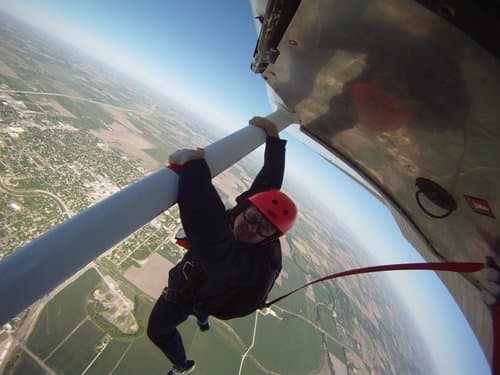
A static line is a cord, a length of nylon webbing, attached to the floor of the airplane on one end. The other end connects to your parachute container. At about 3,500 feet, you climb out and hang from the wing strut. It's a bit like hanging from a pull-up bar, except the wind helps hold you up. As you let go and fall away, the static line opens your container and deploys your parachute.
After you're cleared for freefall, you work one-on-one with your instructor to complete the USPA A-License requirements.
Your path, step by step
- Take the First Jump Course. Friday 6 to 10 pm in the classroom at the K-State Student Union, Saturday 8 to 11 am at the airport. You make your first jump Saturday afternoon. See the course
- Jump 2 is another static line jump, focused on stability.
- Jumps 3 to 5 are still on a static line, but now you throw a dummy handle to practice deploying for yourself.
- Jump 6 is your first real freefall. You're a skydiver now.
- Freefall training builds your skills: moving forward and backward, recovering from instability, docking with other jumpers, and flying your landing pattern.
- A minimum of 25 jumps earns your A-License.
See the full Training Progression for the jump-by-jump breakdown.
Why train with us
- One of the lowest-cost ways to earn a USPA A-License in the Midwest. Plan on about $1,400 all in.
- Go solo from your very first jump.
- Progress to solo freefall in as few as 6 jumps, then one-on-one freefall coaching.
- Every instructor holds a USPA instructional rating and has hundreds, if not thousands, of jumps.
- Made a tandem with us first? Take $50 off your First Jump Course, which brings it to $130.
- Not sure which first jump is right for you? Compare tandem and solo
Who can take it
You must be 18 or older. This is a USPA requirement. Years ago the age was 16 with parental consent, but because parental waivers didn't hold up under some state laws, the USPA changed its stance on underage skydiving.
The general limit is about 220 pounds. Between 220 and 230? Get in touch first and we'll talk it through.
You'll need full use of both arms to steer and land. If you've dislocated a shoulder before, talk to us before you jump solo, because opening forces can dislocate a weakened shoulder. We're not medical experts, so if you have a question about your fitness to jump, ask your doctor.
Questions before you book? Call 785-268-7235 or email [email protected].
First Jump Course
What the course covers
To make a static line jump, a jump where a cord attached to the aircraft opens your parachute as you leave, you first take our First Jump Course. It runs over a Friday evening and a Saturday morning, covering everything you need to exit the aircraft, operate your parachute, and fly yourself to a soft landing.
The course fee covers all your training, your semester club dues, and your first jump. When it's over, you'll have jumped from a plane on your own and landed safely.
What you'll learn
In this two-day course, you'll be taught and asked to demonstrate the skills needed to skydive by yourself:
- Identifying the parts of your parachute and harness system, and what each does
- The right way to enter and exit the aircraft
- How to spot and correct potential problems
- How to control your parachute after it opens
- How to set up a safe, injury-free landing
At the end, you're ready to make your first jump with our USPA-certified instructors.
The jump
At about 3,500 feet, you're attached to the airplane by a static line. As you let go, the static line deploys your parachute. Once it's open, an instructor guides you to the ground by radio in your helmet.
Back on the ground, you may be able to jump again if there's time after everyone has gone once. You're welcome to hang around the drop zone, watch the experienced jumpers, and join us afterward at Joe Snuffy's or La Fiesta in Abilene.
Class schedule
The course runs across two parts, then your jump:
- Friday evening, 6 to 10 pm: classroom session at the K-State Student Union. The exact room is emailed to you after you sign up.
- Saturday morning, 8 to 11 am: hands-on practical training at Abilene Municipal Airport.
- Saturday afternoon: you make your first jump, usually between noon and 5 pm, weather permitting.
We schedule courses at the start of every college semester plus a couple during the summer. Got a large group who wants to take the course together? We can arrange a special class. Email [email protected].
Reserve early. Spots fill up.
Course pricing
- First Jump Course: $180
- First Jump Course after a tandem with us: $130
The $180 covers your instruction, your first jump, rental of student gear for that jump, and club dues for the semester. That is the full price of your first jump.
A $50 deposit holds your seat when you book. The remaining $130 is due at the course. The deposit isn't refundable if you miss the Friday session. If weather pushes your jump, your deposit stays with your booking and we'll tell you the next available date.
After that, training jumps average about $50, and you can earn your license in as few as 25 jumps.
Age and weight limits
You must be 18 or older to skydive. This is a USPA requirement.
The general limit is about 220 pounds. Between 220 and 230? Get in touch first and we'll talk it through. Our student harnesses are certified under Technical Standards Order c23b, which sets a maximum exit weight of 254 pounds. Subtract the gear and that leaves about 220 pounds for the jumper.
Retake policy
Here's how retakes work:
- Within 30 days of your last jump: retake the Saturday morning portion at no cost. If it's a new semester, you'll owe club dues.
- Within 120 days: sit through the full course again at no retrain charge. New semester means club dues.
- Beyond 180 days: sit through the full course and pay a $20 instructor fee, plus club dues for the new semester. Any jumps already on your account stay there.
Miss Friday and you can't jump Saturday, so plan for both. The deposit isn't refundable if you miss the Friday session.
Weather and timing
You'll usually jump between noon and 5 pm on Saturday, though we can't promise an exact time. Weather, aircraft maintenance, or the unexpected can push your first jump to another day. After class, the jump is on you to schedule, and sooner is better while the training is fresh. We jump nearly every weekend the weather is good.
For instructor availability, email [email protected] or ask in our Facebook group. Before you drive out, check live jump conditions.
Reserve a seat
$180, or $130 if you've already jumped tandem with us. A $50 deposit holds the seat. Questions? Call 785-268-7235.
Training Progression
Every jump below builds on the last. You start solo on a static line, learn to deploy for yourself, then move into longer and longer freefalls while adding real air skills. A minimum of 25 jumps earns your A-License.
This part is written for enrolled students. The jump names below are the ones your instructor will use, so we've left them exactly as they are.
The jumps
0. First Jump Course Attend the First Jump Course on one of our scheduled dates.
1. First Jump Your first jump after the course. The static line deploys your parachute as you fall away from the plane.
2. Static Line Jump Same as your first jump, focused on staying stable through deployment.
3 to 5. Practice Throw Still on a static line, but now with a job. We put a dummy handle in your BOC, the bottom-of-container pouch where your pilot chute lives, that you throw to simulate a freefall deployment. The goal: throw the dummy handle before the static line opens your parachute, while staying stable.
6. First Freefall Your first non-static-line jump, a 5-second delay. Same as before, except the handle is real. Throw your pilot chute as you fall away from the plane.
7. First 10-Second Delay Count to seven, then arch, reach, pull. See Dive Flow Sheet 7.
8. Second 10-Second Delay Objectives: stability and altitude awareness using your altimeter. An instructor is in freefall with you. See Dive Flow Sheet 8.
9. First 15-Second Delay Objectives: altitude awareness, boxman position, 90-degree turns, wave-off, rear riser turns. See Dive Flow Sheet 9.
10. Second 15-Second Delay Objectives: altitude awareness, boxman position, 90-degree turns, wave-off, rear riser turns. See Dive Flow Sheet 10.
11. First 30-Second Delay Objectives: bomb-out exit, 180-degree turns times two, rear riser turns, pre-jump equipment checks. See Dive Flow Sheet 11.
12. Second 30-Second Delay Objectives: bomb-out exit, 360-degree turns times two, rear riser turns, cloud clearance. See Dive Flow Sheet 12.
13. 45-Second Delay (180 turn, barrel rolls) Objectives: bomb-out exit, 180-degree turn, barrel rolls, practice flaring. See Dive Flow Sheet 13.
14. 45-Second Delay (Front flip / Back flip) Objectives: poised exit, front flip, back flip. See Dive Flow Sheet 14.
15. 45-Second Delay (Tracking) Objectives: bomb-out exit, tracking, braked landing approach. See Dive Flow Sheet 15.
16. 45-Second Delay (Forward and Backward) Objectives: forward and backward movement, start and stop horizontal movement, docking, front riser turns. See Dive Flow Sheet 16.
17. 45-Second Delay (Swoop and Dock) Objectives: docked exit, dock with fall-rate adjustment. See Dive Flow Sheet 17.
Jumps 18 to 24 Repeat jumps as needed, or fun jumps. You may attempt your check dive early.
25. Check Dive Left 360, right 360, front flip, back flip, swoop and dock.
Pricing
First Jump Course
- First Jump Course: $180
- First Jump Course, after a tandem with us: $130
The First Jump Course includes your first jump, gear rental, and club dues for the semester. A $50 deposit holds your seat when you book online, and the rest is due at the course.
Coached jumps
Every coached jump price below includes our $5 per jump gear rental and one-on-one instruction with a USPA-certified coach or instructor.
- Static Line: $50
- Practice Throw: $50
- First Freefall: $8
- 3,000 to 5,000 ft: $45
- 6,000 ft: $47
- 7,000 ft: $49
- 8,000 ft: $51
- 9,000 ft: $53
- 10,000 ft: $55
First Freefall is $8 because four static line or practice throw jumps at $50 plus that $8 make the $208 the student package below discounts.
For self-supervised student (unlicensed) skydives, use the experienced jumper pricing and add $5 per jump for gear rental. Please pay for all jumps and other charges before you leave for the day.
Student Package: $180
The student package covers jumps 2 through 6: four Static Line or Practice Throw jumps ($50 each) plus your first freefall ($8). That's $28 off a $208 value, with gear rental included. You can buy it after you complete your first Static Line jump.
The "student package" is for anyone learning to jump with us, not just college students.
*Cash or check price. Additional fees apply for credit card and PayPal transactions.*
Pack job: $5
A $5 charge applies for any jump where the student doesn't pack the parachute used. It's included in the Static Line and Practice Throw prices. We teach students to pack their own, and the first jump most students pack for themselves is jump 6, their first freefall.
Club dues (2026)
Dues are $30 per semester or $50 per year, or $10 for a single weekend if you're just passing through. Club membership is required to jump as an unlicensed skydiver, and dues are included in the First Jump Course price.
Questions about pricing? Call 785-268-7235.
Ready to start?
$180 covers the course, your first jump, gear and semester dues. A $50 deposit holds your seat.
Student Quizzes
Free study tool
USPA Student Category Quizzes
Practice the A to H Integrated Student Program right here. 151 questions across 8 categories. Every answer shows the correct response, the 2026 SIM reference, and a short explanation, so you learn the material instead of just guessing. Open to everyone.
A study aid only. Certification and student sign-offs happen with USPA and the club's rated instructors. Study the current material at uspa.org/sim.
Made a tandem with us?
Take $50 off. The First Jump Course is $130 after a tandem with us, and $180 otherwise. A $50 deposit holds your seat. Call 785-268-7235 if you would rather talk it through.